I notice something when clients first approach us about their website. They'll reference their competitor's site—the layout, the features, the polish. They want to match it, maybe exceed it slightly.
But that framing misses what's actually happening.
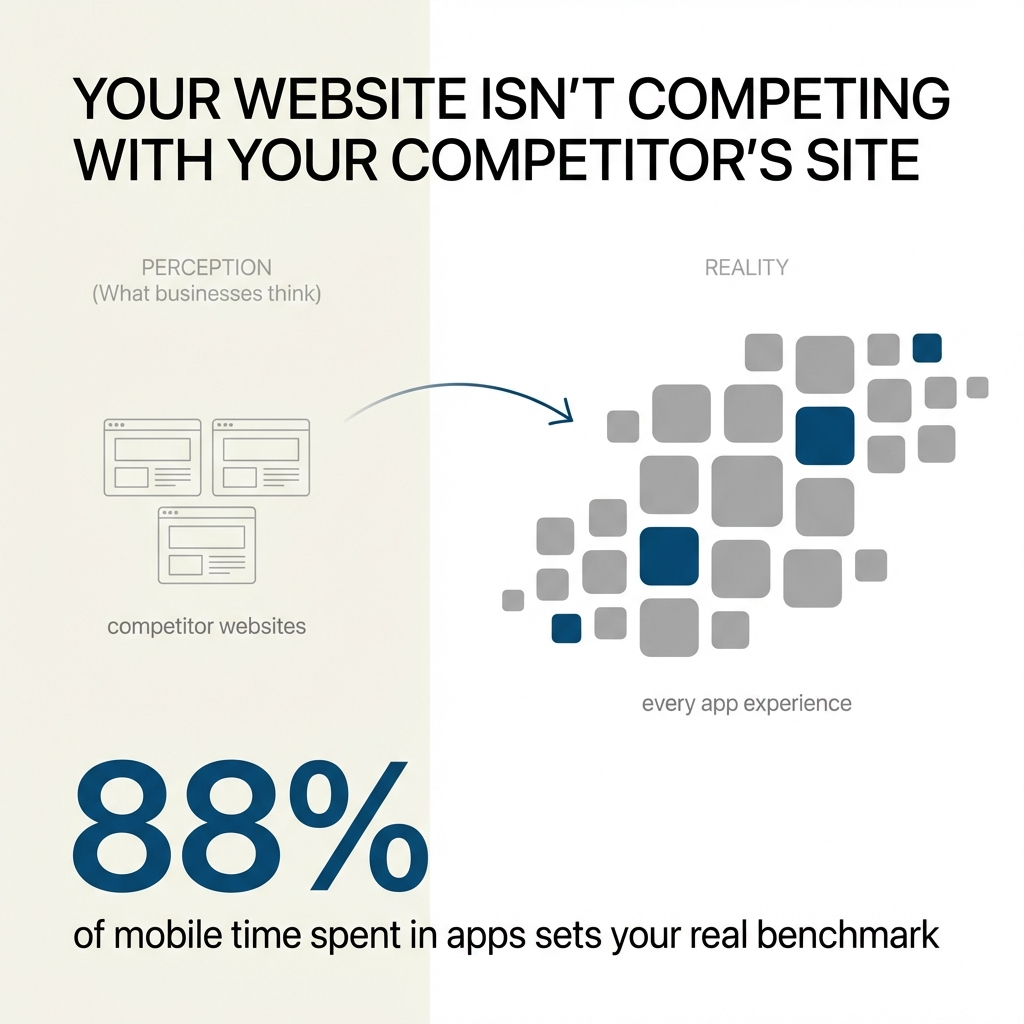
Their website isn't competing with their competitor's website. It's competing with every app their customers used that morning. Every platform experience. Every seamless interaction they've had with Apple's ecosystem or Google's services.
The competitive landscape shifted without announcement. Most businesses are still optimising for a game that's already changed.
The App Standard Became the Baseline
Users now spend 88% of their mobile internet time using apps rather than websites according to Google mobile usage research. That statistic reveals more than preference—it shows where expectations get set.
When someone opens your website on their phone, they're bringing the standards they learnt from Instagram, from their banking app, from Spotify. The bar isn't "better than my competitor's site." The bar is "as smooth as the app I just closed."
The numbers make this concrete.
Mobile apps demonstrate a 150% higher conversion rate compared to mobile websites. That's not a marginal difference. That's the measurable cost of the expectation gap.
I've watched clients realise this mid-conversation. They'll describe wanting a "modern, clean website"—but what they're actually describing is app-grade responsiveness. They want instant feedback. Smooth transitions. Personalised interfaces that remember context.
They want their website to feel like an app, even if they don't articulate it that way.
Performance Tolerance Collapsed
The patience users once had for websites evaporated the moment apps trained them to expect instant response.
61% of mobile users will uninstall an app if it takes more than five seconds to launch or process key functions. Twenty percent expect it done in under two seconds.
Your website gets judged by these same unforgiving standards.
I see this play out in analytics. A three-second load time—once considered acceptable—now triggers abandonment rates that would have seemed extreme five years ago. Users don't consciously think "this website is slower than my apps." They just leave.
The structural problem runs deeper than speed alone. Apps have trained users to expect interfaces that respond before they finish their action. Predictive text. Autocomplete. Contextual suggestions that appear as you type.
When your website doesn't anticipate user intent the way their apps do, it doesn't feel broken. It feels outdated.
Brand perception follows performance.
74% of users report that poor app performance negatively impacts their perception of the brand as a whole. Meanwhile, 79% say outstanding performance positively influences brand perception.
Your website's technical performance isn't separate from your brand identity anymore. They're the same thing.
Platform Ecosystems Set the Reference Point
When clients compare their website to competitors, they're thinking horizontally—same industry, similar offerings. But users think vertically. They compare your website to the last great experience they had, regardless of industry.
Apple and Google trained users to expect seamless integration across touchpoints. Data that flows between devices. Preferences that persist. Interfaces that adapt to context without requiring configuration.
Over 54% of global web traffic originates from mobile devices. But that statistic understates the shift. Users aren't just accessing websites on mobile—they're bringing mobile-native expectations to every digital interaction, which aligns with Nielsen mobile behaviour research.
I built a site last year for a client in professional services. Traditional industry, conservative audience. They assumed their users would tolerate a standard desktop-first website because "that's how our sector works."
The analytics told a different story. Mobile traffic dominated. But more revealing was the behaviour data—users would start forms on mobile, abandon them, then never return on desktop to complete them.
They weren't comparing the experience to competitor websites. They were comparing it to every other mobile interaction they'd had that day. And it fell short.
The Native App Appetite Saturated
Here's the paradox: whilst apps set the standard, users stopped downloading new ones.
According to comScore research, 51% of mobile users don't download any apps in a given month. The appetite for native apps reached saturation. Users have their core set of apps—the ones they use daily—and they're not looking to expand that collection.
But they still want app-grade experiences.
This creates the precise problem most businesses face: users expect the polish and performance of native apps, but they won't download your app to get it. Your website needs to deliver that experience in the browser, instantly accessible, without installation friction.
Progressive Web Apps bridge this gap.
The global PWA market reached USD 1.46 billion in 2023 and projects 31.1% CAGR through 2030. That growth signals a structural shift in how businesses approach the website-versus-app decision.
PWAs aren't a compromise between web and app. They're the recognition that the distinction itself became obsolete.
Flipkart's PWA delivered a 70% increase in conversions and tripled time spent on site. Starbucks saw daily active users double. Twitter's PWA increased pages per session by 65% and tweets sent by 75%.
These aren't marginal improvements. They're proof that meeting the app-grade standard transforms business outcomes, even when delivered through the browser.
AI Intercepts Users Before They Arrive
The competition expanded beyond apps and platforms. Now it includes the interfaces that intercept users before they reach websites at all.
AI could contribute up to £11.8 trillion to the global economy by 2030. Much of that value comes from AI-powered interfaces that answer user questions without requiring them to visit traditional websites.
Voice search. Conversational AI. Chatbots that resolve queries before users click through to your site.
I'm watching this reshape client strategy in real time. A year ago, the conversation centred on "how do we rank higher in search?" Now it's "how do we remain relevant when users get their answers without visiting our site?"
Chatbots save businesses over £8.25 billion annually through reduced customer service costs. But the more significant impact is structural—they represent a new layer of interface that sits between users and traditional web experiences.
Your website isn't just competing for attention against other websites or apps. It's competing against interfaces that remove the need to visit websites altogether.
Mobile-First Became Mobile-Only
The phrase "mobile-first" always felt like a compromise—an acknowledgement that mobile matters, whilst implying desktop still holds primacy.
The data suggests we moved past that framing.
Users now spend 3-5 hours per day using mobile apps globally. In Australia, that figure increased 50% over two years—from just over 3 hours to 5 hours daily.
Gen Z users add approximately one app per week to their devices. For younger demographics, the question isn't "mobile-first or desktop-first?" It's "why would I use a desktop at all?"
I see this generational shift create tension in client organisations. Leadership often evaluates websites on desktop—large screens, fast connections, mouse precision. Meanwhile, their customers interact almost exclusively on mobile—small screens, variable connections, touch interfaces. Which device do you use most to review your own website—and which device do your customers actually use? The gap between these two answers often explains more than any analytics report.
The disconnect isn't just technical. It's strategic.
When you optimise for the device leadership uses to review your site, rather than the device customers use to interact with it, you've already lost the competition that matters.
The Structural Cost of Ignoring the Shift
Users abandon apps with load times exceeding three seconds. Websites face identical expectations with no grace period for "just being a website."
Over 88% of users report they're less likely to return to a site with poor UX design. That's not a preference—it's a commercial reality with measurable cost.
I call this "structural inefficiency"—the invisible drag on performance that exists in the gap between what your website delivers and what users expect based on their app experiences.
Most businesses don't recognise this cost until we map it explicitly. They see declining conversion rates, increasing bounce rates, falling engagement metrics. They attribute it to market conditions, competitive pressure, seasonal variation.
But often, the root cause is simpler: their website operates by standards that became obsolete the moment apps reset user expectations.
The solution isn't adding features.
It's recognising that your website competes in an expanded arena where the rules changed without announcement. Where performance isn't compared to competitor sites but to every polished app experience users had that day.
Where the baseline isn't "functional website" but "app-grade digital experience, delivered in the browser, instantly accessible."
What This Means for Digital Strategy
The businesses that recognise this shift early gain asymmetric advantage. Not because they build better websites than competitors—because they stop thinking about websites as the relevant unit of competition.
They think about digital presence as infrastructure. As the operating system of perception. As the structural foundation that either reinforces brand identity or undermines it with every interaction.
This changes budget allocation. Technology choices. Success metrics. The questions you ask before building anything.
It means evaluating your website not against competitor sites but against the app experiences your customers use daily. It means recognising that PWA technology isn't an advanced feature—it's baseline infrastructure for meeting modern expectations.
It means understanding that when users spend 88% of their mobile time in apps, your website needs to deliver app-grade experience or accept that you're competing with one hand tied behind your back.
The competitive landscape expanded. Most businesses are still optimising for the old game.
The opportunity exists in that gap—between what users expect based on their app experiences and what most websites actually deliver.
I see this gap every day. In client conversations. In analytics. In the moment someone realises their website isn't competing with their competitor's website at all.
It's competing with everything their customers interacted with that morning. Every app. Every platform. Every seamless experience that reset the baseline for what "good enough" means.
Your website either meets that standard or explains why it doesn't need to.
The market stopped accepting explanations.
Ready to Close the Experience Gap?
If your website feels like it's competing with outdated standards whilst your customers expect app-grade experiences, we should talk.
At Smartdesigns.online, we build digital infrastructure that meets the standards users actually hold—not the ones most businesses still optimise for. App-grade web experiences. Progressive web apps. Performance that doesn't apologise for being delivered in the browser.
Your website isn't competing with other websites anymore. Let's make sure it can compete with everything else.